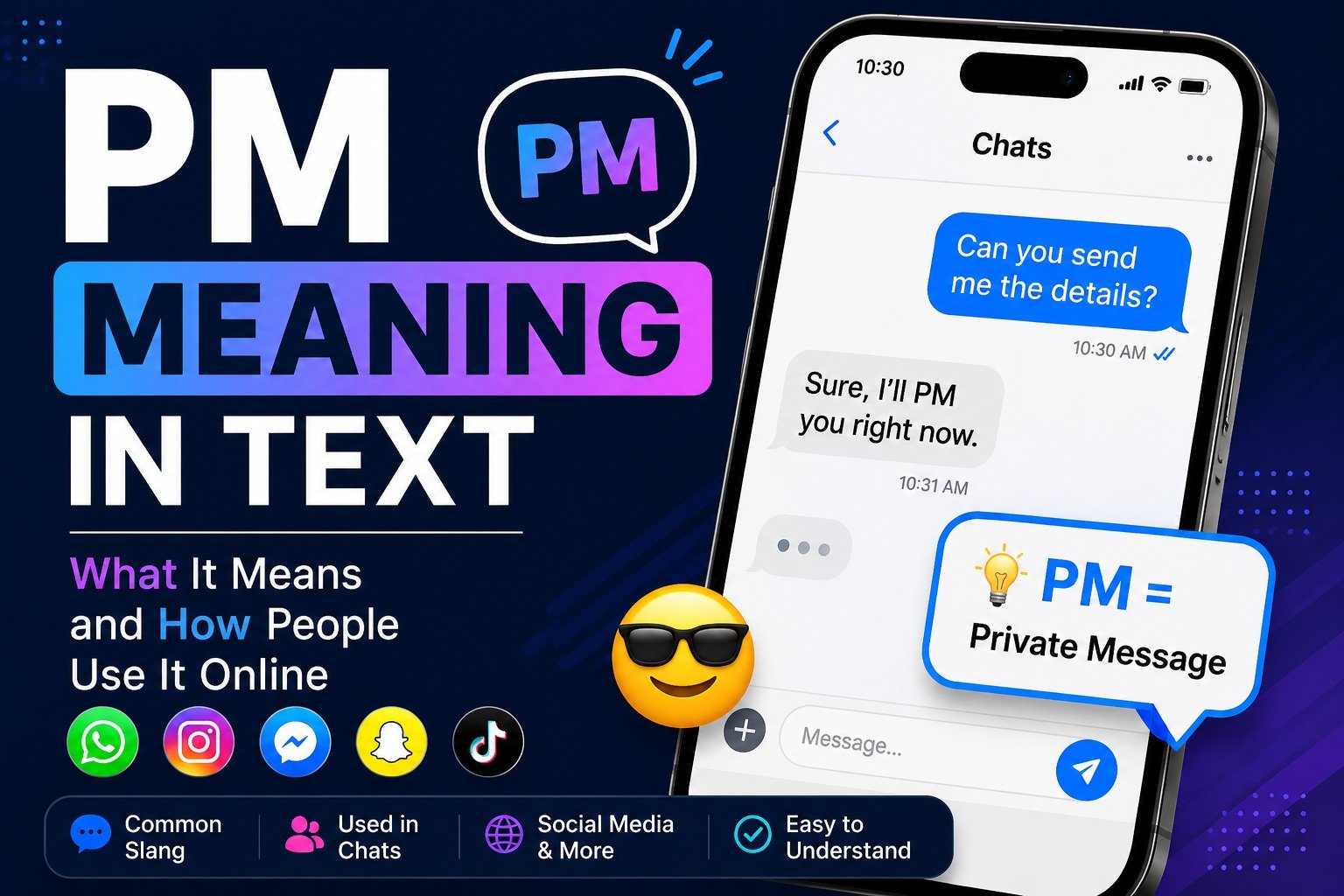

PM Meaning in Text usually refers to a private message in texting, chat, and online conversations. PM, PM me, PM?, and PM for details are common short forms used on social media and messaging platforms.
In messages, WhatsApp, TikTok, Instagram, and Snapchat, PM is often used to ask someone to communicate privately instead of speaking publicly. Its meaning, full form, definition, and interpretation depend on the context, tone, and platform. The term is common in Internet slang, internet abbreviations, chat abbreviations, and American texting culture, including the USA and United States. Friends may use it in casual conversations, while workplace chats and professional conversations may use it for private interaction.
However, PM has multiple meanings. It can also refer to post meridiem, a time reference connected with time, which may cause confusion, misunderstandings, and common mistakes. Understanding these examples, platform-specific usage, digital habits, and communication shifts makes the meaning more obvious. In the digital world, knowing how to understand, respond, respond naturally, connect, and communicate confidently helps improve clarity, confidence, privacy, and digital expression. The origin, history, texting meaning, and use of PM also show how everyday language continues to change.
Let’s dive in!
Quick Answer: What Does PM Mean in Text?
PM usually means “private message” in texting, social media, forums, and online communities. When someone says “PM me,” they’re asking you to send them a private message rather than replying publicly.
For example:
“PM me the details.”
This means:
“Send me the details in a private message.”
The abbreviation can also mean post meridiem when used with a time, such as 6 PM, or terms such as Prime Minister and Project Manager in the right context. Major dictionaries recognize both the private-message and other meanings of PM.
| Example | Meaning of PM |
| “PM me the address.” | Private message |
| “Check your PMs.” | Private messages |
| “PM for details.” | Private message |
| “The meeting starts at 7 PM.” | Post meridiem |
| “The PM gave a speech.” | Prime Minister |
| “Ask the PM about the schedule.” | Project Manager, depending on context |
So, if PM appears next to an action such as “me,” “send,” or “check,” private message is usually the intended meaning.
What Does PM Mean in Texting?
In texting and online communication, PM stands for “private message.” It describes a message sent privately to another person through a website, forum, social platform, or online service.
Oxford defines a PM as a message that only the sender and intended recipient can read on social media or an online forum. It also recognizes PM as a verb, meaning to send someone a private message.
For example:
- “PM me.” → Send me a private message.
- “I’ll PM you.” → I’ll send you a private message.
- “Did you PM her?” → Did you send her a private message?
- “Check your PMs.” → Check your private messages.
- “PM for details.” → Contact me privately for more information.
The important word here is private. Instead of putting the information in a public comment or forum thread, the person wants the conversation moved into a private messaging area.
PM Can Work as a Verb
One useful detail gets overlooked in many explanations of PM meaning in text: people don’t only use PM as a noun.
They also use it as a verb.
For instance:
“I’ll PM you tonight.”
Here, “PM” means “send you a private message.”
English speakers commonly turn abbreviations into verbs in casual digital communication. That’s why you’ll see forms such as PM’d, PMed, and PMing in informal writing. Oxford specifically lists PM as a verb with these forms.
What Does “PM Me” Mean?
“PM me” means “send me a private message.”
It’s one of the most common ways you’ll encounter PM online.
Imagine someone posts:
“I have two tickets available. PM me if you’re interested.”
They’re not asking you to leave your phone number in the comments. They’re telling you to contact them privately.
Likewise:
“PM me your username.”
means:
“Send me your username through a private message.”
Common “PM Me” Examples
| Phrase | Plain-English meaning |
| PM me | Send me a private message |
| PM me later | Message me privately later |
| PM me your number | Send your number privately |
| PM me if interested | Contact me privately if you’re interested |
| PM me for more information | Send me a private message to get more information |
The exact messaging system depends on the platform. One site might call it private messaging, another might call it direct messaging, and another may simply call it messages.
The underlying idea remains the same: move the conversation away from the public space.
What Does “PM for Details” Mean?
“PM for details” means “send me a private message if you want more information.”
You’ll often see this phrase in online communities, listings, social-media posts, and discussion groups.
For example:
“Selling a used camera. PM for details.”
The person doesn’t want to put every detail in the public post. They want interested people to contact them privately.
This might involve:
- Price
- Availability
- Location
- Contact information
- Additional photographs
- Specifications
- Delivery details
- Event information
A Simple Example
Suppose someone posts:
“Selling my gaming monitor. PM for details.”
A public response might be:
“How much?”
But the seller may prefer:
“PM me for the price and condition.”
The conversation then moves into private messages.
Important: “PM for details” doesn’t automatically mean the information is secret or suspicious. It simply means the person wants to discuss it privately. Context still matters.
What Does “Check Your PMs” Mean?
When someone says “check your PMs,” they’re telling you to look at your private-message inbox.
The s simply makes PM plural.
So:
- PM = one private message
- PMs = multiple private messages or the private-message inbox
For example:
“I sent you the information. Check your PMs.”
means:
“I’ve sent the information privately. Go to your messages and read it.”
You’ll especially encounter this language in online communities, forums, gaming communities, and older social platforms.
PM vs. DM: Are PM and DM the Same?
For everyday online communication, PM and DM usually mean essentially the same thing: a private one-to-one message.
The difference comes from the terminology each platform or community chooses.
PM means private message.
DM means direct message.
Cambridge defines a DM as a private message sent through a social-media website that only the intended recipient can see. It also recognizes DM as a verb, such as “DM me.”
Here’s the practical distinction:
| Term | Full form | Typical meaning |
| PM | Private Message | A private online message |
| DM | Direct Message | A private online message |
| IM | Instant Message | A message sent through an instant-messaging service |
| Text | Text message | A message sent through a mobile messaging system |
Why Do People Say “DM” More Often?
The terminology varies by platform and by generation of internet culture.
PM has long been associated with forums and online communities. DM became especially familiar through social-media platforms that use “direct message” terminology.
Today, you may hear:
- “DM me on Instagram.”
- “Send me a DM.”
- “PM me on the forum.”
- “Check your PMs.”
In normal conversation, these phrases all point toward the same basic action: send a message privately.
The platform’s own terminology is usually the safest guide.
PM Meaning on Different Online Platforms
The exact word used for private communication can change from one platform to another.
PM on Forums
Forums are one of the environments strongly associated with the term private message.
A forum might have public threads where everyone can read a discussion. A PM system lets members communicate separately.
For example:
“I’ve answered your question in a PM.”
This means the person has continued the discussion privately.
PM on Social Media
People may still say PM even when the platform itself uses another term.
Someone might write:
“PM me your contact details.”
They aren’t necessarily referring to a feature literally labeled “PM.” They’re using familiar shorthand for private communication.
PM in Online Communities
Gaming groups, hobby communities, marketplace groups, and discussion boards can all use PM as casual shorthand.
Common phrases include:
- “PM me your offer.”
- “I’ll PM you.”
- “Check PM.”
- “PM sent.”
- “PM for details.”
These phrases are especially useful when a public conversation needs to move somewhere more private.
PM Meaning in Text Messages vs. Online Messages
There’s an important distinction between a private message and a traditional SMS text message.
If someone says:
“PM me.”
they generally mean message me privately through the platform you’re currently using.
They don’t necessarily mean:
“Send me an SMS to my phone number.”
For example, if you’re talking on a forum and someone says “PM me,” they probably want you to use the forum’s private-message feature.
If you’re already exchanging ordinary phone texts, saying “PM me” would be less natural because the conversation is already private.
Compare These Phrases
| Phrase | Usually means |
| Text me | Send me a phone text |
| PM me | Send me a private message |
| DM me | Send me a direct message |
| Email me | Send me an email |
| Call me | Phone me |
The surrounding platform usually gives you the answer.
Other Meanings of PM in Text
Although private message is the key meaning in online conversations, PM isn’t limited to messaging.
That’s where context becomes essential.
PM Means Post Meridiem
When PM appears next to a clock time, it means post meridiem, a Latin expression meaning after noon.
For example:
- 1 PM
- 4:30 PM
- 7 PM
- 11:45 PM
Cambridge defines p.m. as the abbreviation used for times in the afternoon, evening, and night.
So:
“I’ll call you at 8 PM.”
has nothing to do with private messages.
It means:
“I’ll call you at eight o’clock in the evening.”
AM vs. PM
The 12-hour clock divides the day into two 12-hour periods.
| Abbreviation | Meaning | General period |
| AM | Ante meridiem | Before noon |
| PM | Post meridiem | After noon |
For practical purposes:
- 8 AM = morning
- 12 PM = noon
- 3 PM = afternoon
- 8 PM = evening
- 11 PM = late evening/night
The expression post meridiem literally means “after noon.”
The Tricky Part: 12 AM and 12 PM
The two noon/midnight labels can confuse people.
12 PM = noon.
12 AM = midnight.
If there’s any possibility of misunderstanding, writing noon or midnight is often clearer.
PM Meaning in Politics: Prime Minister
In political writing, PM commonly stands for Prime Minister.
For example:
“The PM announced new measures today.”
Here, PM clearly refers to the head of government rather than a private message.
Oxford and Cambridge both list Prime Minister as a meaning of PM.
Context makes the difference.
Compare:
“PM me when you’re ready.”
with:
“The PM met with officials.”
The first refers to private messaging. The second refers to a political leader.
Read More: Moots Meaning in Text: What “Moots” Means on Social Media
PM Meaning in Business: Project Manager
In workplace conversations, PM can also mean Project Manager.
For example:
“Ask the PM whether the deadline has changed.”
If the conversation is about software development, construction, marketing, or another project-based environment, PM may refer to the person managing the project.
Cambridge’s dictionary includes project manager as a business meaning of PM.
However, business terminology can vary. In some companies, PM may also be used for Product Manager or other roles.
That’s why the surrounding conversation matters.
Compare the Context
“PM me the document.”
PM = private message
“The PM approved the timeline.”
PM = likely Project Manager
“The PM addressed Parliament.”
PM = Prime Minister
“Let’s meet at 6 PM.”
PM = post meridiem
The same two letters can point to four completely different meanings.
How to Tell What PM Means in a Text
You don’t need to memorize every possible definition. Look at the words around PM.
When PM Appears With “Me”
If you see:
- “PM me”
- “PM me later”
- “PM me the details”
- “PM me your number”
PM almost certainly means private message.
When PM Appears With a Time
If you see:
- “5 PM”
- “8:30 PM”
- “Meet at 7 PM”
PM means post meridiem.
When PM Appears in Politics
If you see:
- “The PM announced…”
- “The PM met with…”
- “The PM said…”
PM probably means Prime Minister.
When PM Appears at Work
If you see:
- “Ask the PM.”
- “The PM approved it.”
- “The PM needs the report.”
PM may mean Project Manager, depending on the organization.
A Quick Context Test
| What appears around PM? | Most likely meaning |
| me / you / sent / inbox | Private Message |
| a clock time | Post meridiem |
| government / Parliament / election | Prime Minister |
| project / deadline / team / schedule | Project Manager |
This simple test solves most cases without guesswork.
Real-World Examples of PM Meaning in Text
Seeing the abbreviation in complete sentences makes the distinction much easier.
Example: Private Message
“PM me when you get home.”
Meaning: Send me a private message when you get home.
Example: Private Message
“PM for details about the event.”
Meaning: Contact me privately to receive the information.
Example: Private Message
“I already PM’d you the address.”
Meaning: I already sent you the address in a private message.
Example: Time
“The movie starts at 9 PM.”
Meaning: The movie starts at nine in the evening.
Example: Prime Minister
“The PM spoke to reporters.”
Meaning: The Prime Minister spoke to reporters.
Example: Project Manager
“The PM moved the meeting to Friday.”
Meaning: The Project Manager moved the meeting to Friday, assuming that workplace context supports that interpretation.
A Short Case Study: One Abbreviation, Four Meanings
Consider these four sentences:
A. “PM me the photos.”
B. “The train leaves at 6 PM.”
C. “The PM addressed the country.”
D. “The PM approved the project plan.”
At first glance, the abbreviation looks identical.
Yet each sentence gives you enough information to identify its meaning:
| Sentence | Meaning | Why? |
| “PM me the photos.” | Private Message | “Me” indicates an action involving messaging |
| “The train leaves at 6 PM.” | Post meridiem | PM follows a clock time |
| “The PM addressed the country.” | Prime Minister | The political context identifies the role |
| “The PM approved the project plan.” | Project Manager | The project context points toward a workplace role |
The lesson is simple: don’t interpret an abbreviation in isolation. Read the entire sentence.
Is PM Still Used in Texting?
Yes. PM remains a recognized abbreviation for private messaging, particularly in forums, online communities, and casual digital communication.
At the same time, DM is often more familiar in modern social-media conversations.
The two terms aren’t necessarily rivals. They’re different pieces of internet vocabulary that often describe the same basic behavior.
Oxford continues to define PM as both a private-message noun and a verb for sending a private message.
So phrases such as these remain perfectly understandable:
- “PM me.”
- “Send me a PM.”
- “Check your PMs.”
- “I’ll PM you.”
If the platform primarily uses DM, however, saying “DM me” will usually sound more natural to its users.
Is PM Formal or Informal?
PM is generally informal shorthand.
It’s perfectly normal in:
- Text messages
- Social-media conversations
- Online forums
- Gaming communities
- Casual workplace chats
- Community groups
For formal communication, spelling out “private message” may be clearer.
For example, instead of writing:
“Please PM me if you have questions.”
a formal customer-facing message might say:
“Please send us a private message if you have any questions.”
Neither version is inherently wrong. The best choice depends on your audience.
A Useful Rule
Use the language your audience already understands.
If you’re talking casually with people who regularly use PM, the abbreviation is efficient.
If you’re writing for a broad audience, spelling it out removes ambiguity.
Common Misunderstandings About PM
“PM” Always Means Private Message
Not necessarily.
As we’ve seen, PM can mean:
- Private Message
- Post Meridiem
- Prime Minister
- Project Manager
There are also specialized meanings in technical and professional fields.
PM and DM Are Completely Different
Usually, no.
In everyday online communication, PM and DM both refer to private one-to-one messaging. Cambridge defines DM as a private social-media message, while Oxford gives PM the same general private-message meaning.
“PM Me” Means Text My Phone
Not usually.
“PM me” generally means “send me a private message through the platform you’re using.”
“Text me” is the more natural phrase when someone specifically wants an SMS or mobile text.
PM Means Something Secret
Not necessarily.
A private message is simply a message that isn’t displayed publicly to everyone in the conversation or community. Private doesn’t automatically mean confidential, hidden, or secret.
PM Is Always the Best Term
Not necessarily.
If you’re on a platform that calls the feature Direct Messages, saying “DM me” will usually fit the platform’s language better.
How to Respond When Someone Says “PM Me”
Your response depends on what the person wants.
If you’re comfortable continuing privately, simply open the platform’s messaging feature and send the message.
For example:
“Sure, I’ll PM you.”
If you’re unsure what they mean, you can ask:
“Do you mean a private message?”
If you don’t want to move the conversation away from the public discussion, you can politely say:
“Can we keep this in the comments?”
The abbreviation itself doesn’t require a complicated response. Once you understand PM meaning in text, the instruction is straightforward.
FAQs:
1. What does PM mean in text?
PM usually means private message when used in texting, chat, or online conversations. It means communicating with someone privately rather than publicly.
2. What does “PM me” mean?
PM me means “send me a private message.” People commonly use it on social media, WhatsApp, Instagram, TikTok, and other messaging platforms.
3. Does PM have other meanings?
Yes. PM can also mean post meridiem, which is a time reference used for times from noon to midnight. The context usually makes the intended meaning clear.
4. Is PM common in social media?
Yes. PM is a common abbreviation in Internet slang and digital communication. It is often used when someone wants to continue a conversation privately.
5. How should I respond when someone says “PM me”?
If you want to continue the conversation privately, you can simply send them a private message. If the meaning isn’t clear, asking for clarification can help avoid misunderstandings.
Conclusion:
PM is a simple but flexible abbreviation with different meanings depending on the context. In most texting and social media conversations, it means private message, while in other situations it can refer to post meridiem. Understanding the surrounding words, platform, and tone makes it easier to understand PM and communicate clearly.