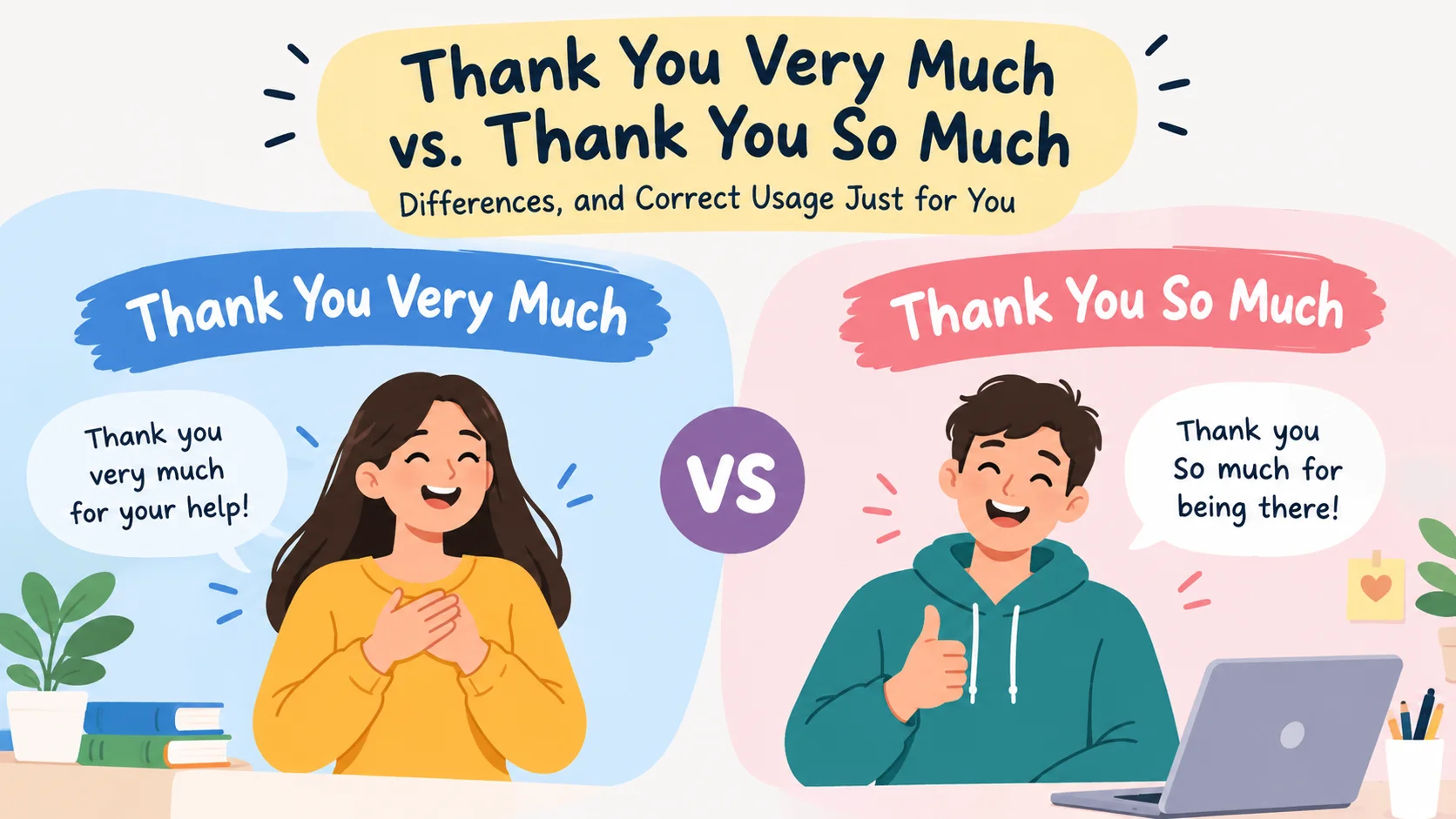

Thank You Very Much vs. Thank You So Much may seem interchangeable, but each phrase creates a slightly different impression in everyday communication.
Both phrases express gratitude and good manners in personal and professional settings. However, Thank You Very Much often sounds more formal, making it suitable for business emails, written thank-you notes, and professional communication. Thank You So Much usually feels warmer and more personal, making it a better fit for casual conversations and heartfelt thanks. Both expressions are grammatically correct, so your choice depends on the situation, your relationship with the other person, and the tone you want to convey.
The word So can add stronger emphasis than Very, although both are intensifiers. Thank You So Much has become popular among younger people, particularly in North American English, and it is also common in the U.K. and Ireland. Some people may consider it less genuine when they hear it too often, but frequent use doesn’t automatically make an expression insincere. In my experience, the most appropriate wording depends on the speaker, context, and intended meaning. If you prefer a neutral and reserved tone, Thank You Very Much is a safe choice. If you want to express enthusiasm and deeper appreciation, Thank You So Much may communicate your feelings more naturally.
Let’s dive in!
Quick Answer:
“Thank you very much” and “thank you so much” both express gratitude and appreciation. The main difference lies in the emphasis and tone they often convey.
- Thank you very much: Often sounds polite, formal, or measured. It’s a natural choice when thanking someone for their time, assistance, or consideration.
- Thank you so much: Often sounds warm, personal, or enthusiastic. It works especially well when you want to express heartfelt appreciation.
- In formal emails: Both expressions are acceptable. Choose the one that matches the tone of your message.
- In casual conversations: Both sound natural, although “thank you so much” may feel more emotionally expressive.
- In terms of grammar: Both phrases are correct and widely used in English.
The simplest rule: Use “thank you very much” when you want a polite, measured expression of gratitude. Choose “thank you so much” when you want to emphasize warmth or personal appreciation. Either phrase can work in both situations.
Comparison Overview
The following table highlights the key differences between these expressions. Remember that these are common tendencies rather than strict rules.
| Feature | Thank You Very Much | Thank You So Much |
| Basic meaning | Expresses gratitude | Expresses gratitude |
| Common tone | Polite, measured, or formal | Warm, personal, or enthusiastic |
| Emphasis | Strong appreciation | Strong appreciation, often with added emotional warmth |
| Professional emails | Very suitable | Very suitable when a warm tone fits |
| Personal messages | Natural and appropriate | Often feels especially warm |
| Spoken conversations | Polite and versatile | Friendly and expressive |
| Grammar | Correct | Correct |
| Level of politeness | Can be very polite | Can be very polite |
| Best use | Formal thanks or measured appreciation | Heartfelt thanks or enthusiastic appreciation |
The difference isn’t about one phrase being correct and the other incorrect. Instead, it concerns the impression you want to create.
For example, you might write “Thank you very much for your consideration” to a hiring manager. When a friend helps you move into a new apartment, “Thank you so much for helping me” may feel more personal.
Both choices are natural. The context helps determine which one sounds best.
Main Differences Between “Thank You Very Much” vs. “Thank You So Much”
Although both phrases communicate gratitude, their wording creates slightly different nuances. Understanding these distinctions helps you choose more precisely.
Meaning and Emphasis
The word “very” intensifies an adjective or adverb. In “thank you very much,” it emphasizes the degree of gratitude being expressed.
The word “so” can also intensify an expression. In “thank you so much,” it adds emphasis and can make the gratitude feel more immediate or emotionally expressive.
Consider these examples:
- “Thank you very much for your assistance.” This sounds polite and appreciative.
- “Thank you so much for your assistance.” This can sound warmer and more personal.
Both sentences express strong appreciation. Neither one automatically communicates greater gratitude in every situation.
The speaker’s intention matters just as much as the words. A sincere, quiet “thank you very much” can convey deeper appreciation than a hurried “thank you so much.”
Tone and Emotional Warmth
Tone is one of the most noticeable differences between these expressions.
“Thank you very much” can sound composed and professional. It works well when you want to express appreciation without making your message overly emotional.
“Thank you so much” often feels more conversational. It can communicate excitement, relief, affection, or heartfelt appreciation.
Imagine that a colleague covers your shift when an unexpected problem arises. You might say:
- “Thank you very much for covering my shift.” This expresses clear, respectful appreciation.
- “Thank you so much for covering my shift!” This may communicate extra warmth and relief.
The second expression isn’t necessarily more sincere. It simply makes a warmer tone easy to convey, especially with an enthusiastic voice or an exclamation point.
Formality and Professionalism
Many English speakers associate “thank you very much” with formal or professional communication. The phrase fits business correspondence, customer interactions, and conversations with people you don’t know well.
However, “thank you so much” is also appropriate in professional settings. It can make workplace communication feel friendly without sacrificing respect.
For example:
- Formal: “Thank you very much for considering my application.”
- Warm and professional: “Thank you so much for taking the time to meet with me.”
Both sentences are professional. The first emphasizes consideration, while the second highlights appreciation for someone’s time.
Which Phrase Sounds More Natural?
Naturalness depends on the situation rather than a universal rule.
If you’re thanking a stranger for holding a door open, either expression works. If you’re writing a formal letter, “thank you very much” might fit the overall tone particularly well. If someone has done you a significant personal favor, “thank you so much” may communicate your feelings more directly.
The best test is simple: Does the expression fit your relationship with the recipient and the reason you’re thanking them?
If it does, you’re probably making a natural choice.
What Does “Thank You Very Much” Mean?
“Thank you very much” is a common English expression used to show appreciation for someone’s actions, help, kindness, time, or consideration. It strengthens the basic expression “thank you” by emphasizing the degree of gratitude.
You can use it in formal situations, everyday conversations, and professional correspondence. It works when you’re thanking someone for a small courtesy or a significant favor.
For example, if a manager reviews your work carefully, you might say, “Thank you very much for your feedback.” If a neighbor returns something you lost, you could say, “Thank you very much for bringing this back.”
When “Thank You Very Much” Works Best
This expression is particularly useful when you want to sound polite, respectful, or professionally appreciative.
Common situations include:
- Professional communication: Thanking a manager, client, colleague, or business partner.
- Formal requests: Acknowledging someone’s time or consideration.
- Customer service: Expressing appreciation for assistance or patience.
- Academic settings: Thanking a teacher, professor, or administrator.
- Everyday interactions: Showing gratitude to a stranger or acquaintance.
Here are some examples:
| Situation | Example |
| Job application | Thank you very much for considering my application. |
| Workplace | Thank you very much for your helpful feedback. |
| Customer service | Thank you very much for your patience. |
| Education | Thank you very much for explaining the assignment. |
| Everyday life | Thank you very much for holding the door. |
Notice that these sentences identify the reason for the gratitude. That small detail makes your appreciation more specific and meaningful.
Can “Thank You Very Much” Sound Cold or Distant?
Sometimes, but the phrase itself isn’t cold or unfriendly.
In a brief professional exchange, it may sound appropriately measured. In a personal conversation, however, a flat delivery might seem distant if the situation calls for more emotional warmth.
Consider two situations:
- A customer says, “Thank you very much for your assistance,” with a friendly smile.
- Someone responds to a close friend’s thoughtful gesture with a flat “Thank you very much” and immediately changes the subject.
The words are identical, but the surrounding behavior changes their perceived meaning.
Practical tip: If you want “thank you very much” to sound warm, add a specific detail or use a friendly tone. For example, “Thank you very much for checking on me yesterday. It meant a lot.”
What Does “Thank You So Much” Mean?
“Thank you so much” expresses gratitude with emphasis. It often sounds warm, enthusiastic, and personal, especially when someone has helped you or done something thoughtful.
The phrase works in both casual and professional English. You might use it when a friend gives you a gift, a coworker helps with a deadline, or a recruiter schedules an interview.
For example:
- Thank you so much for remembering my birthday.
- Thank you so much for helping me prepare for the interview.
- Thank you so much for sending the documents so quickly.
- Thank you so much for your thoughtful message.
Each example expresses appreciation while keeping the tone natural.
When “Thank You So Much” Works Best
This phrase is especially useful when you want to communicate warmth or make your appreciation feel personal.
You can use it when:
- Someone goes out of their way to help you.
- A friend or family member gives you a thoughtful gift.
- A colleague supports you during a busy period.
- Someone offers encouragement when you’re struggling.
- A person takes extra time to explain something.
- You receive kind messages, congratulations, or unexpected support.
For instance, imagine that a friend spends an entire afternoon helping you prepare for an important exam. Saying, “Thank you so much for helping me study” acknowledges the effort and conveys personal appreciation.
You could also say, “Thank you very much for helping me study.” That’s correct, too. The choice depends on the tone you want to create.
Is “Thank You So Much” Too Informal?
No. Although the phrase often sounds conversational, it isn’t restricted to casual situations.
It’s appropriate in many workplace emails, business conversations, and professional thank-you messages. The important question is whether it fits the communication style and the relationship.
For example:
- Professional: “Thank you so much for sharing the updated report.”
- Academic: “Thank you so much for your guidance throughout the semester.”
- Customer service: “Thank you so much for bringing this issue to our attention.”
- Personal: “Thank you so much for being there when I needed you.”
All four examples are natural. The first three show that the expression can work in professional settings without sounding careless or disrespectful.
However, if you’re writing a highly formal legal letter or a ceremonial statement, you may prefer a more restrained expression. That preference reflects the formality of the document, not a grammatical restriction.
Is “Thank You Very Much” More Formal Than “Thank You So Much”?
In many situations, yes, “thank you very much” can sound more formal or measured. However, this is a tendency rather than a fixed rule.
The phrase often fits formal correspondence because it expresses appreciation directly without necessarily sounding emotionally intense. Meanwhile, “thank you so much” can make a message feel warmer and more conversational.
Compare these examples:
More formal or measured:
Thank you very much for your time and consideration.
Warm and professional:
Thank you so much for taking the time to discuss the position with me.
Both sentences work in a professional setting. The difference lies in their emphasis, not their correctness.
Formality Depends on the Whole Message
A single phrase doesn’t determine whether an entire email sounds professional. Your greeting, vocabulary, sentence structure, and purpose all contribute to the overall tone.
For example, this email is professional:
“Hi Jordan,
Thank you so much for sending the revised proposal. The updates clarify the project timeline and next steps.
Best, Alex”
The expression “thank you so much” doesn’t make the message unprofessional. The rest of the email remains clear, respectful, and appropriate.
Similarly, “thank you very much” can sound sarcastic or stiff when the surrounding context suggests irritation.
The takeaway: Choose your phrase based on the tone you need rather than assuming one expression always sounds more formal.
Is “Thank You So Much” More Sincere or Personal?
“Thank you so much” often communicates warmth because speakers use it to emphasize their appreciation. It can feel especially natural when someone has done something meaningful or unexpected.
Suppose your coworker notices you’re overwhelmed and offers to finish part of your workload. You might respond, “Thank you so much for stepping in. You really helped me out.”
That response does more than acknowledge the favor. It also explains why the help mattered.
However, sincerity doesn’t come from the word “so” alone. People can express genuine gratitude through either phrase.
Consider these two examples:
- “Thank you very much for supporting me during a difficult time.”
- “Thank you so much for supporting me during a difficult time.”
Both express meaningful appreciation. The first may sound measured, while the second may sound warmer to some readers.
How to Make Either Phrase Sound More Sincere
If you want your gratitude to feel genuine, focus on the reason you’re thankful.
Try these approaches:
- Be specific: Mention the exact thing the person did.
- Acknowledge the effort: Recognize the time, thought, or care involved.
- Explain the impact: Tell the person how their action helped you.
- Match your tone to the relationship: Speak naturally instead of forcing exaggerated emotion.
For example, compare “Thank you so much” with “Thank you so much for staying late to help me finish the presentation. I couldn’t have completed it on time without your support.”
The second message feels more personal because it identifies the favor and explains its impact.
When to Use “Thank You Very Much”
Choose “thank you very much” when you want a clear, polite expression of gratitude that fits a wide range of situations.
In Professional Emails
This phrase works well when acknowledging meetings, feedback, documents, interviews, or assistance.
Examples:
- Thank you very much for your time today.
- Thank you very much for reviewing the proposal.
- Thank you very much for considering my request.
- Thank you very much for your prompt response.
It’s particularly useful when communicating with clients, hiring managers, senior colleagues, or people you don’t know well.
When Thanking Someone for Their Time
Time is a common reason to express formal appreciation. If someone meets with you, answers questions, or reviews your work, “thank you very much for your time” is a natural choice.
For example:
“Thank you very much for meeting with me this afternoon. I appreciated the opportunity to learn more about the role.”
This wording is respectful and specific without sounding overly emotional.
When You Want a Measured Tone
Sometimes you want to express gratitude without making a message feel too enthusiastic. “Thank you very much” can suit these situations.
For example, after receiving routine assistance from a service representative, you might say, “Thank you very much for clarifying the policy.”
The phrase communicates appreciation while maintaining a professional tone.
Read More: Lies Ahead vs. Lays Ahead: Differences, Examples, and Correct Usage Just for You
When to Use “Thank You So Much”
Choose “thank you so much” when you want to emphasize personal appreciation or communicate a warmer tone.
When Someone Goes Out of Their Way to Help
A person who gives extra time or effort often deserves a specific expression of thanks.
For example:
“Thank you so much for helping me move this weekend. I really appreciate you giving up your Saturday.”
The second sentence makes the gratitude more personal by recognizing the effort involved.
When Responding to Gifts and Kind Gestures
This phrase works naturally when someone remembers an important date, gives you a thoughtful present, or offers unexpected kindness.
Examples:
- Thank you so much for the beautiful flowers.
- Thank you so much for remembering my birthday.
- Thank you so much for such a thoughtful gift.
- Thank you so much for making me feel welcome.
You can use “thank you very much” in these situations, too. However, “thank you so much” may better match an excited or affectionate response.
When Expressing Relief or Appreciation
Imagine that a colleague helps you fix a problem shortly before a presentation. You might say, “Thank you so much for catching that error before the meeting.”
The expression conveys appreciation while naturally fitting a moment of relief.
You don’t need to reserve it for major favors, either. It works for small acts of kindness when you want to sound especially friendly.
“Thank You Very Much” vs. “Thank You So Much” in Emails
Email communication requires you to balance politeness, clarity, and the relationship you have with the recipient. Fortunately, both expressions work well in written messages.
The best choice depends on what you’re thanking someone for and how formal the email needs to sound.
Examples of Professional Thank-You Emails
Example 1: Thanking a hiring manager
“Dear Ms. Taylor,
Thank you very much for considering my application. I appreciate the opportunity to discuss my qualifications and experience.
Best regards, Michael”
This version sounds professional and measured. It suits a formal hiring process.
Example 2: Thanking a colleague
“Hi Sarah,
Thank you so much for helping me finish the presentation. Your suggestions made the final version much clearer.
Best, Emma”
This message feels friendly while remaining professional. It also explains how the colleague’s help improved the work.
Example 3: Thanking a client
“Hello Mr. Davis,
Thank you very much for sharing your feedback. We’ll review your suggestions as we finalize the project.
Best regards, Daniel”
Here, “thank you very much” fits a courteous business exchange.
Which Phrase Should You Use in an Email?
| Email situation | Suggested expression | Why it works |
| Job application | Thank you very much | Polite and professional |
| Friendly workplace message | Thank you so much | Warm and natural |
| Client feedback | Either phrase | Both express professional appreciation |
| Personal favor from a colleague | Thank you so much | Highlights personal gratitude |
| Formal request or consideration | Thank you very much | Fits a measured tone |
| Quick thank-you after a meeting | Either phrase | Both sound appropriate |
These recommendations aren’t strict rules. If your workplace has a friendly communication style, “thank you so much” may be the better fit even when writing to a manager.
“Thank You Very Much” vs. “Thank You So Much” in Everyday Conversation
In everyday speech, both expressions sound natural. Your voice, facial expression, and relationship with the listener often matter more than the exact wording.
In Face-to-Face Conversations
Imagine that someone holds the door open while you’re carrying several bags.
You might say, “Thank you very much!” or “Thank you so much!”
Either response is polite. A smile and a sincere tone can make both sound friendly.
In Text Messages
Text messages lack vocal cues, so readers interpret tone through wording, punctuation, and context.
For example:
- “Thank you very much for your help.” Sounds polite and straightforward.
- “Thank you so much for your help!” Sounds warm and enthusiastic.
- “Thank you so much!!” Adds excitement, although multiple exclamation points may feel excessive in formal communication.
Neither expression is inherently better for texting. Choose the one that sounds like you.
In Social Media Messages
Both phrases work well when thanking someone for a compliment, birthday wishes, or support.
For example:
“Thank you so much to everyone who wished me a happy birthday!”
Or:
“Thank you very much to everyone who took the time to send birthday wishes.”
The first feels more conversational, while the second sounds slightly more measured. Both communicate appreciation clearly.
Can “Thank You Very Much” Sound Sarcastic?
Yes. Although “thank you very much” normally expresses gratitude, speakers can use it sarcastically when their tone or the surrounding situation suggests irritation.
Sarcasm occurs when someone uses words to communicate an attitude that differs from their literal meaning.
Consider these examples:
Sincere gratitude: “Thank you very much for helping me carry these boxes.”
Possible sarcasm: Someone spills coffee on your paperwork, then walks away. You might respond, “Thank you very much,” with a frustrated tone.
In the second example, the words don’t express genuine appreciation. The situation and delivery signal annoyance.
Is “Thank You So Much” Also Sarcastic Sometimes?
Absolutely. Neither phrase has a special exemption from sarcasm.
Imagine that someone repeatedly interrupts your presentation. You might say, “Thank you so much for letting me finish,” in a pointed tone.
The literal wording sounds appreciative, but the intended message is critical.
Remember: Sarcasm depends on context and delivery. Don’t assume someone is being sarcastic simply because they use “thank you very much.”
Common Mistakes to Avoid
Both expressions are straightforward, but a few misunderstandings can lead to awkward communication.
Assuming One Phrase Is Always More Polite
“Thank you very much” often sounds formal, but that doesn’t make it universally more polite.
Likewise, “thank you so much” can sound perfectly professional. The situation, relationship, and delivery determine whether either expression feels appropriate.
Treating “Thank You So Much” as Informal Only
The phrase works in professional emails, academic communication, and workplace conversations. You don’t need to avoid it simply because you want to sound professional.
Assuming “Thank You Very Much” Is Always Sincere
The phrase can express genuine appreciation, but speakers can also use it sarcastically. The words alone don’t reveal the speaker’s full intention.
Repeating the Same Phrase Too Often
If you’re writing a long email, using “thank you very much” in every paragraph may sound repetitive.
Instead, vary your wording naturally:
- Thank you for your time.
- I really appreciate your help.
- Many thanks for the update.
- I’m grateful for your support.
These alternatives keep your message clear without making it sound forced.
Forgetting to Explain What You’re Thankful For
A general expression of gratitude is perfectly acceptable. However, adding a specific reason often makes your message more meaningful.
Compare these examples:
- “Thank you so much.”
- “Thank you so much for explaining the process. Your advice helped me avoid a costly mistake.”
The second message acknowledges the person’s contribution and shows why it mattered.
Other Ways to Express Gratitude
Sometimes neither phrase perfectly matches the tone you want. English offers several alternatives that express appreciation with different levels of warmth and formality.
| Expression | Tone | Example |
| Thank you | Neutral and versatile | Thank you for your message. |
| Thanks so much | Friendly and conversational | Thanks so much for your help! |
| Many thanks | Concise and polite | Many thanks for the update. |
| I really appreciate it | Personal and direct | I really appreciate your support. |
| I sincerely appreciate your help | Formal and respectful | I sincerely appreciate your assistance. |
| I’m very grateful | Heartfelt | I’m very grateful for your kindness. |
| I can’t thank you enough | Strong appreciation | I can’t thank you enough for everything. |
| Thanks a lot | Casual; sometimes sarcastic | Thanks a lot for picking that up. |
Which Alternative Should You Choose?
- For professional emails: Use “many thanks” or “I sincerely appreciate your assistance.”
- For friends and family: Try “thanks so much” or “I really appreciate it.”
- For significant favors: Use “I’m very grateful” or “I can’t thank you enough.”
- For everyday situations: A simple “thank you” is often enough.
The most effective expression is the one that communicates your gratitude clearly without overstating your feelings.
FAQs
What is the difference between Thank You Very Much and Thank You So Much?
Both phrases express gratitude, but their tone can differ. Thank You Very Much often sounds more formal and reserved, while Thank You So Much usually feels warmer and more enthusiastic.
Is Thank You Very Much more formal than Thank You So Much?
Yes, Thank You Very Much often sounds more formal, especially in business emails, professional conversations, and written thank-you notes. However, both expressions are polite and appropriate in many situations.
Is Thank You So Much grammatically correct?
Yes, Thank You So Much is grammatically correct. People commonly use it in everyday conversations, friendly messages, and situations where they want to express strong appreciation.
Can I use Thank You Very Much in casual conversations?
Yes, you can use Thank You Very Much in casual conversations. It may sound slightly more formal than necessary in some situations, but it remains a natural and polite way to express thanks.
Why do people say Thank You So Much instead of Thank You Very Much?
People often choose Thank You So Much because it sounds warm, personal, and enthusiastic. The word so adds emphasis and can make the expression feel more heartfelt.
Does Thank You So Much sound insincere?
No, not necessarily. Some people may find it less genuine when someone repeats it frequently without showing real appreciation. However, sincerity depends more on the speaker’s feelings, tone, and actions than on the phrase itself.
Which phrase should I use in a professional email?
Thank You Very Much is often a safe choice for professional emails because it sounds polite and suitably formal. You can also use Thank You So Much when you want to express warmer appreciation, especially toward someone who has provided meaningful help.
Conclusion:
Both Thank You Very Much and Thank You So Much are correct, polite ways to express gratitude. The main difference lies in their tone and the level of emphasis they convey. The first often sounds more formal and reserved, while the second feels warmer and more enthusiastic.
When choosing between these expressions, consider the situation, your relationship with the other person, and the message you want to convey. Use Thank You Very Much for professional settings or when you prefer a neutral tone. Choose Thank You So Much when you want to express heartfelt appreciation in everyday conversations. Ultimately, the best expression is the one that feels natural and sincere to you.


1 thought on “Thank You Very Much vs. Thank You So Much: Differences, and Correct Usage Just for You”