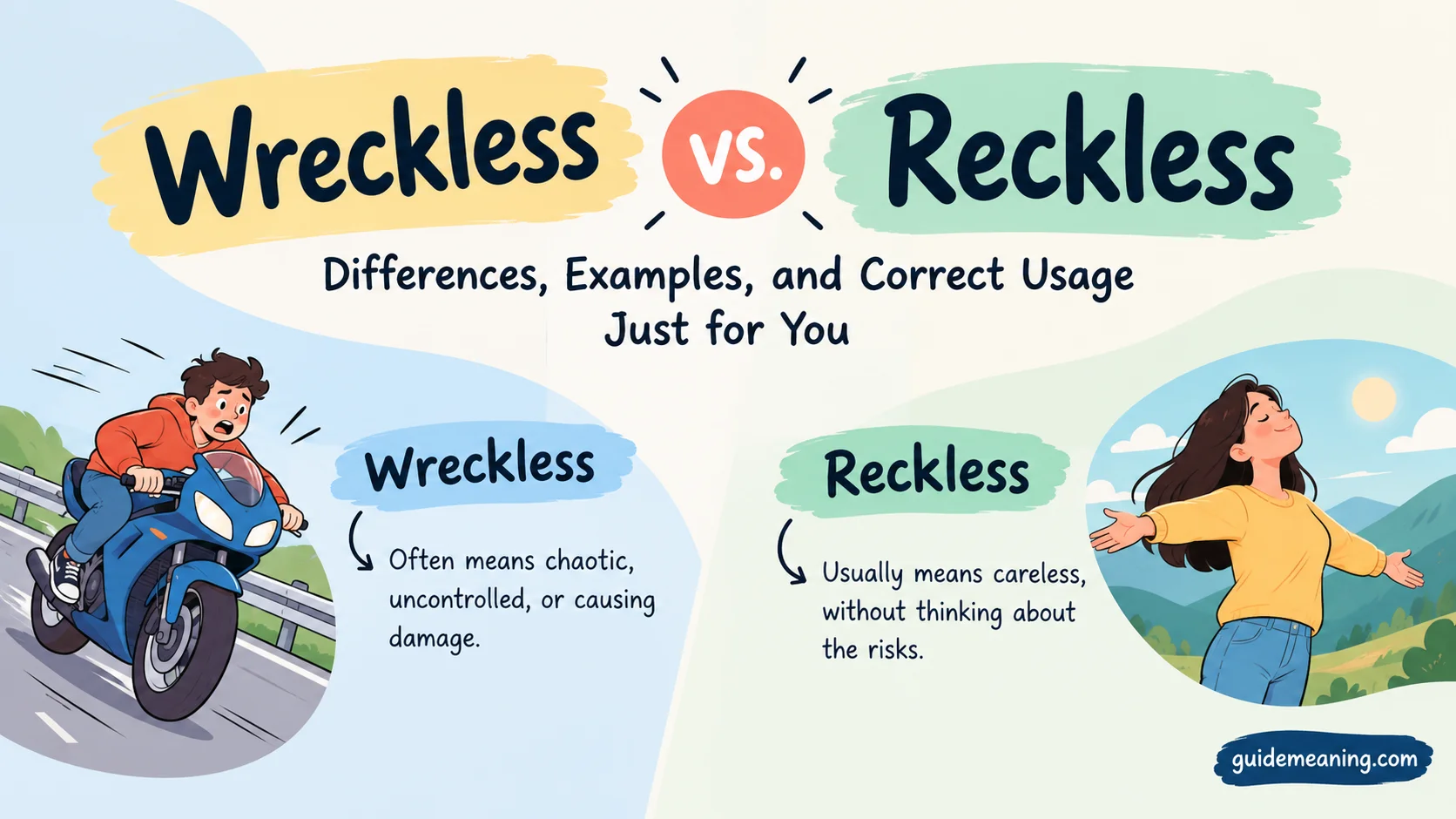

Wreckless vs. Reckless can confuse confident writers because these words look alike and may seem related in everyday language. However, only reckless is the correct term in standard English. It is an adjective describing someone who acts without thinking about the consequences. Reckless behavior shows carelessness, disregard for safety, and unsafe behavior. For example, a reckless driver who drives at high speeds through a crowded area or moves extremely fast in heavy traffic risks accidents, injury, and serious consequences. Such actions show poor decision making and a lack of concern for risks.
The correct spelling is reckless in American English and modern English. Wreckless is a nonstandard spelling and a common misspelling that writers should avoid. The confusion happens because wreck means to damage or destroy something, making wreckless look like a logical spelling. However, reckless comes from an older English word linked to lacking concern. Grammar examples, pronunciation, and the word’s actual meaning can help you remember the difference. Instead of judging a word by its appearance, learn its meaning and practice using the correct spelling.
Writers, students, and professionals can improve their knowledge through practice, examples, and observation. Choosing the right word strengthens grammar, word choice, and correct usage while reducing errors and spelling mistakes in everyday writing. Clear spelling also supports clarity, effective communication, accurate linguistic expression, and easily understood messages. These skills matter in written communication and spoken communication skills. Even a small mistake may seem harmless, but it can affect writing perception in professional writing, academic writing, business writing, content writing, and blogging. Using the standard word helps maintain accuracy and stronger professional communication.
Let’s dive in!
Quick Answer:
Reckless is the correct standard English spelling. It describes someone who acts without giving enough thought to danger, risk, or possible consequences.
Wreckless is generally an incorrect spelling when you intend to express that meaning. Although people sometimes use it online, it isn’t the standard alternative to reckless.
Consider these examples:
- Correct: His reckless driving put everyone on the road at risk.
- Incorrect: His wreckless driving put everyone on the road at risk.
- Correct: She made a reckless decision without considering the financial consequences.
- Incorrect: She made a wreckless decision without considering the financial consequences.
The essential distinction is simple: reckless describes risky or irresponsible behavior, while wreckless usually reflects a spelling mistake.
You don’t need to cause a wreck to behave recklessly. A person can make a reckless investment, take a reckless gamble, or show reckless disregard for another person’s safety without causing an accident.
Comparison Overview
The following table summarizes the main differences between wreckless and reckless.
| Feature | Reckless | Wreckless |
| Standard English spelling | Yes | No, for the intended adjective |
| Part of speech | Adjective | Usually a misspelling in this context |
| Meaning | Showing little concern for danger or consequences | No separate standard meaning in ordinary usage |
| Common expressions | Reckless driving, reckless spending, reckless behavior | No standard equivalent expressions |
| Formal writing | Appropriate | Avoid unless intentionally used as a name or coined term |
| Example | His reckless actions endangered others. | His wreckless actions endangered others. |
| Best choice for everyday writing | Yes | No |
One important detail deserves attention: wreckless can appear intentionally in a business name, stage name, username, song title, or creative expression. In those cases, its spelling may be deliberate. That doesn’t make it the standard spelling of the adjective reckless.
For ordinary writing, choose reckless whenever you mean careless about danger, risk, or consequences.
What Does Reckless Mean?
Reckless is an adjective that describes someone who takes risks without giving enough thought to the possible harm or consequences. It can describe a person’s attitude, a specific action, or a decision that exposes people or property to unnecessary danger.
For example, imagine someone driving far above the speed limit through a crowded neighborhood. That driver isn’t simply making a mistake. The behavior shows disregard for the danger posed to other people.
Recklessness doesn’t always involve physical danger, though. Someone who spends their entire savings on an investment without researching it may also make a reckless decision.
Common Uses of Reckless
Here are several common expressions and what they mean:
- Reckless driving: Operating a vehicle in a dangerous manner without proper regard for safety.
- Reckless behavior: Acting in ways that expose yourself or others to unnecessary risks.
- Reckless spending: Spending money without adequately considering your financial situation or future needs.
- Reckless decisions: Making choices without properly weighing their risks or consequences.
- Reckless disregard: Showing little or no appropriate concern for an important duty, risk, or responsibility.
Consider these examples:
- The cyclist’s reckless behavior endangered pedestrians.
- He made a reckless investment without checking the company’s financial records.
- Her reckless comments damaged an otherwise productive business relationship.
- The manager showed reckless disregard for workplace safety.
In each example, the word suggests more than an ordinary mistake. It highlights a failure to give sufficient weight to foreseeable risks or consequences.
Is Reckless Always a Negative Word?
Usually, yes. Reckless generally expresses criticism because it suggests poor judgment or insufficient concern for possible harm.
However, writers sometimes use it dramatically to describe bold, daring, or uncontrolled behavior. For example, a novelist might describe a character as having a reckless spirit to emphasize their willingness to take chances.
Even in that context, the word retains a sense of risk or insufficient caution. If you want to praise someone for taking sensible risks, words such as bold, adventurous, or courageous may communicate your meaning more clearly.
What Does Wreckless Mean?
Wreckless is generally a misspelling of reckless when the intended meaning involves dangerous or careless behavior. Standard English dictionaries recognize reckless as the adjective used for this meaning.
The mistake is understandable because wreck refers to destruction or serious damage. Since reckless driving can cause a wreck, the spelling wreckless may look logical at first glance.
However, English spelling doesn’t always follow the connections that seem most obvious. The word reckless developed from an older word related to caring or paying attention, not from wreck.
For example, these sentences demonstrate the usual distinction:
- Incorrect: The driver was wreckless on the icy road.
- Correct: The driver was reckless on the icy road.
- Incorrect: His wreckless spending exhausted his savings.
- Correct: His reckless spending exhausted his savings.
The correct spelling remains reckless regardless of whether the situation involves a car, money, workplace safety, or personal decisions.
Can Wreckless Ever Be Used Intentionally?
Yes. Although wreckless isn’t the standard spelling of the adjective discussed here, people may deliberately use it as a proper name, brand, username, or creative expression.
For example, a musician might choose Wreckless as a stage name to create a visual association with destruction or rebellious behavior. A fictional character could also use the spelling as part of a nickname.
Such uses depend on the author’s intention. They don’t establish wreckless as an accepted replacement for reckless in ordinary sentences.
Practical rule: Use reckless in standard writing. Preserve Wreckless when reproducing an intentional name or title exactly.
What Is the Difference Between Wreckless and Reckless?
The main difference is standard spelling and usage. Reckless is the established English adjective, while wreckless is usually an error when used to describe someone who disregards risk.
The confusion often comes from the visual similarity between the words. Both contain the letters reck and end in less, so adding a w can seem harmless. Nevertheless, that extra letter changes the spelling from the standard form.
The difference becomes especially important in professional writing, school assignments, news articles, and formal correspondence. Readers may understand what you mean when you write wreckless, but the mistake can distract them from your message.
Does Reckless Mean Without a Wreck?
No. This is a common way to misinterpret the spelling.
The ending -less often means without or lacking, as in careless, hopeless, and fearless. Because wreckless appears to combine wreck with -less, readers may interpret it as meaning “without a wreck.”
That interpretation doesn’t establish a standard English meaning for the word. Reckless has its own established history and means showing insufficient concern for danger or consequences.
For example:
- A driver can behave recklessly without causing an accident.
- A person can make a reckless financial decision without losing money immediately.
- A company can act recklessly even if no one suffers harm in the end.
The word describes the nature of the behavior, not simply the final result.
Why the Extra W Is Incorrect
The word reckless isn’t formed by combining wreck and less. Its historical root is an older English verb associated with caring, taking heed, or paying attention.
Adding a w creates a misleading connection with wreck. That’s why wreckless driving is a spelling error in ordinary usage, even though a wreck might result from reckless driving.
Why Is Reckless the Correct Spelling?
The correct spelling becomes easier to remember when you understand the word’s history.
In simpler terms, reckless originally carried the idea of not caring or not paying attention to consequences. That historical meaning closely matches how English speakers use the word today.
The Meaning Behind Reckless
The word contains the suffix -less, which commonly expresses a lack or absence of something.
You can see the same pattern in familiar English words:
| Word | Basic meaning |
| Careless | Lacking sufficient care |
| Fearless | Lacking fear |
| Hopeless | Lacking hope |
| Thoughtless | Showing insufficient thought or consideration |
| Reckless | Showing insufficient concern for risk or consequences |
These examples help explain the word’s structure, although reckless has a historical root that isn’t the same as the modern word wreck.
Read More: Thank You Very Much vs. Thank You So Much: Differences, and Correct Usage Just for You
Reckless in Sentences: Examples and Correct Usage
Examples make the difference easier to recognize. The word reckless can describe actions involving physical safety, money, personal relationships, or professional responsibilities.
Reckless Driving
Driving is one of the most familiar contexts for this adjective.
- The police officer warned the driver about his reckless driving.
- Driving at an unsafe speed through a crowded street is reckless.
- Her reckless driving placed other road users in danger.
In these sentences, reckless describes driving that disregards safety. It doesn’t mean that an accident has already occurred.
Reckless Behavior
The word also applies to general actions that expose people to unnecessary danger.
- His reckless behavior worried his family.
- The hikers made a reckless choice by entering the storm without proper equipment.
- She criticized the team’s reckless approach to safety.
These examples show that the word can describe a pattern of behavior or a single action.
Reckless Decisions
People sometimes make choices quickly without considering what could go wrong.
- Accepting the offer without reading the contract was reckless.
- He made a reckless decision that threatened the company’s future.
- Their reckless planning left the entire team unprepared.
A decision doesn’t have to end badly to deserve this description. The word focuses on the quality of the decision and the risks the person ignored.
Reckless Spending
Financial writing frequently uses reckless to describe spending or borrowing without sufficient concern for future consequences. Cambridge’s business dictionary also uses the word in contexts involving borrowing, lending, and spending.
Examples include:
- Reckless spending left him unable to cover his monthly bills.
- The business suffered after years of reckless financial decisions.
- She avoided reckless purchases by comparing prices and reviewing her budget.
The word is especially useful when the spending creates an avoidable financial risk.
Reckless Disregard
The phrase reckless disregard describes a serious lack of concern for a risk, responsibility, or relevant consideration.
- The report criticized the company for its reckless disregard for worker safety.
- His reckless disregard for deadlines delayed the entire project.
- The complaint alleged reckless disregard for customer privacy.
This expression often appears in formal, professional, and legal discussions. However, its precise legal significance depends on the applicable law and circumstances.
Reckless vs. Careless vs. Irresponsible
Although reckless, careless, and irresponsible share similar meanings, they don’t describe exactly the same behavior. Choosing the right adjective helps you express the problem more precisely.
| Word | Meaning | Example |
| Reckless | Ignores significant risks or possible consequences | He drove recklessly through heavy traffic. |
| Careless | Fails to give enough attention or take proper care | She made a careless spelling mistake. |
| Irresponsible | Fails to meet a duty or act responsibly | He was irresponsible when he missed an important deadline without warning anyone. |
| Rash | Acts too quickly without sufficient thought | Buying the expensive car after one test drive was rash. |
| Foolhardy | Takes a foolish risk despite the danger | Attempting the dangerous climb without equipment was foolhardy. |
| Thoughtless | Fails to consider other people’s feelings or needs | His thoughtless comment upset his friend. |
When Should You Use Reckless?
Use reckless when someone disregards a meaningful risk or fails to take possible consequences seriously.
Example: The contractor took a reckless approach to electrical safety.
When Should You Use Careless?
Use careless when someone makes a mistake because they don’t pay enough attention or exercise proper care.
Example: The editor made a careless mistake while checking the document.
When Should You Use Irresponsible?
Use irresponsible when someone neglects a duty or fails to meet an expected responsibility.
Example: Leaving children unsupervised near a busy road was irresponsible.
The distinction is straightforward: careless emphasizes insufficient attention, reckless emphasizes disregard for risk, and irresponsible emphasizes a failure of responsibility.
Common Mistakes When Using Reckless
Even experienced writers sometimes confuse reckless with wreckless. Other mistakes involve the word’s meaning, grammar, or use in sentences.
Using Wreckless Instead of Reckless
This is the most common mistake addressed in this guide.
- Incorrect: The driver received a warning for wreckless behavior.
- Correct: The driver received a warning for reckless behavior.
Remember that the standard adjective contains no w.
Assuming Reckless Requires an Accident
The word describes behavior that disregards danger, not an accident itself.
- Incorrect interpretation: A driver is reckless only after causing a crash.
- Correct interpretation: A driver can act recklessly even if no crash occurs.
For example, speeding dangerously through a crowded parking lot can be reckless even when everyone reaches their destination safely.
Using Reckless When Careless Fits Better
Not every mistake involves significant risk.
- Less precise: He made a reckless typo in the report.
- More natural: He made a careless typo in the report.
A simple typing error usually reflects inattention rather than disregard for danger. However, a serious error made while knowingly ignoring major risks might reasonably be described as reckless.
Confusing Reckless With Wrecked
The words reckless and wrecked have different meanings and grammatical functions.
- Reckless: An adjective describing risky behavior.
- Wrecked: Usually a past-tense verb or past participle describing something damaged or ruined.
For example, The reckless driver wrecked the car uses both words correctly. The adjective describes the driver’s behavior, while the verb describes what happened to the vehicle.
How to Remember the Correct Spelling
You don’t need a complicated spelling trick to remember reckless. A simple association can help you avoid the mistake.
Remember Reckless Without the W
The easiest rule is:
Reckless = risky behavior without enough concern for consequences.
Write reckless without the w, even when the sentence mentions a wreck or accident.
Connect Reckless With Risk
Think about these two sentences:
- The reckless driver ignored the warning signs.
- The reckless investor ignored the financial risks.
Both sentences describe someone who failed to give enough attention to possible consequences. This connection between recklessness and risk can help you remember the spelling.
Check the Word Before Publishing
If you aren’t sure which spelling to use, consult a dictionary rather than relying on how the word looks.
For online articles, emails, school assignments, and business documents, a quick spelling check can prevent an easily avoidable mistake.
Practical Case Studies: Reckless vs. Wreckless in Context
The following hypothetical examples show how the spelling and meaning work in everyday situations.
Case Study: A Dangerous Driving Decision
Imagine a driver approaching an intersection during heavy rain. Instead of slowing down, the driver accelerates through the crossing despite poor visibility.
A sentence describing the situation might read:
The driver’s reckless decision put pedestrians at risk.
Using wreckless would be a spelling mistake because the sentence describes disregard for danger.
Notice that the driver doesn’t need to cause a collision for the word reckless to apply.
Case Study: A Risky Financial Choice
Consider a small-business owner who spends most of the company’s available cash on an untested product without reviewing costs or demand.
You could write:
The owner’s reckless spending left the business struggling to cover essential expenses.
Here, reckless describes a financial decision rather than a physical danger. The spelling stays the same because the meaning hasn’t changed.
Case Study: A Mistake in Professional Writing
Suppose a company publishes an online article containing the phrase wreckless behavior. Readers may understand the intended meaning, but the incorrect spelling can undermine the article’s credibility.
The correction is simple:
- Before: The report examined the effects of wreckless behavior.
- After: The report examined the effects of reckless behavior.
This example illustrates why spelling matters even when readers can understand the message. Correct word choice helps keep attention on the content rather than the error.
FAQs:
Is it wreckless or reckless?
Reckless is the correct spelling in standard English. Wreckless is a common misspelling when describing careless or dangerous behavior.
What does reckless mean?
Reckless means acting without thinking about the possible risks or consequences. For example, driving too fast through heavy traffic is reckless behavior.
Is wreckless a real word?
Wreckless is not an accepted standard spelling of the word reckless. You should avoid using it in formal and everyday writing when you mean careless or irresponsible.
Why do people confuse wreckless and reckless?
People often confuse these words because wreckless looks related to wreck, which means to damage or destroy something. However, reckless is the established spelling for behavior that shows little concern for safety.
Is reckless an adjective?
Yes, reckless is an adjective. It describes a person, action, or decision that ignores risks or possible consequences. For example, His reckless decision caused serious problems.
What is an example of reckless behavior?
Driving at high speeds in a crowded area, ignoring safety rules, or making risky decisions without considering the results are examples of reckless behavior.
How can I remember the correct spelling of reckless?
Remember that reckless is spelled without a w. Practice writing the word in sentences, check its spelling when proofreading, and avoid connecting it directly to the word wreck.
Conclusion:
The difference between wreckless vs. reckless is simple once you understand the correct spelling and meaning. Reckless is the standard English word for careless, irresponsible, or dangerously thoughtless behavior. Wreckless is a common misspelling in this context, even though its connection to the word wreck may seem logical. If you’re writing a blog post, completing an academic assignment, or preparing a professional document, using the correct spelling improves clarity and communication. Remember to choose reckless whenever you describe actions that ignore risks or consequences.




1 thought on “Wreckless vs. Reckless: Differences, and Correct Usage Just for You”